
Australia is home to one of the most culturally diverse communities in the world, and many families celebrating a 21st birthday carry more than one cultural identity. A recipient with a Samoan father and a Cook Islands mother, or Maori and Fijian heritage on different sides of the family, deserves a birthday key that honours both not one that forces a choice between them.
The answer to whether two different cultural patterns can appear on a single birthday key is yes. But how that is done matters enormously. A key that tries to carry two cultures without clear intention can feel crowded and visually confused. A key where two cultures are incorporated thoughtfully feels complete, intentional, and deeply personal.
Why This Question Comes Up So Often
Mixed cultural heritage is not unusual among the families we work with — it is the norm. The majority of Pacific and indigenous communities in Australia have family connections that span multiple island nations, and those connections are a source of pride, not complexity.
The challenge is that most birthday key makers offer a single design field and a single pattern selection. The concept of honouring two cultures within one piece has simply not been built into most ordering systems. Families are left to either pick one culture and set the other aside, or find a maker who understands how to carry both with care.
We have seen firsthand how much it means to a recipient when both sides of their heritage are present on a key that marks such a significant milestone. Getting this right is not just a design challenge — it is an act of respect toward the family and the cultures they carry.
The Two Ways Cultural Patterns Are Incorporated
There are two primary approaches to incorporating dual cultural patterns into a birthday key order, and understanding both helps you decide which is right for your situation before you reach out.
The first approach uses the key surface and the stand as two separate design fields. The key carries the primary cultural pattern of the recipient typically the culture with the strongest personal connection while the stand reflects the second cultural heritage. This creates a complete piece where both cultures are present and visible, but each occupies its own space without competing for the same surface.
The second approach incorporates elements from both cultures directly onto the key surface itself. This works best when the two cultural design systems are compatible in terms of visual structure. Geometric Pacific patterns such as Samoan and Fijian designs can sit alongside each other with careful placement. More organic designs such as Maori koru work may need more considered integration to avoid visual conflict.
We always advise families to discuss both approaches during the quote process rather than making the decision alone. The right approach depends on the specific cultures involved, the design complexity of each, and what the family wants the key to communicate.
Explore our full range of cultural birthday key designs to understand what is possible with each culture.
How the Key and Stand Work as a Dual Culture System
The most elegant solution for dual cultural heritage on a birthday key is one that treats the key and stand as a unified system rather than two separate products.
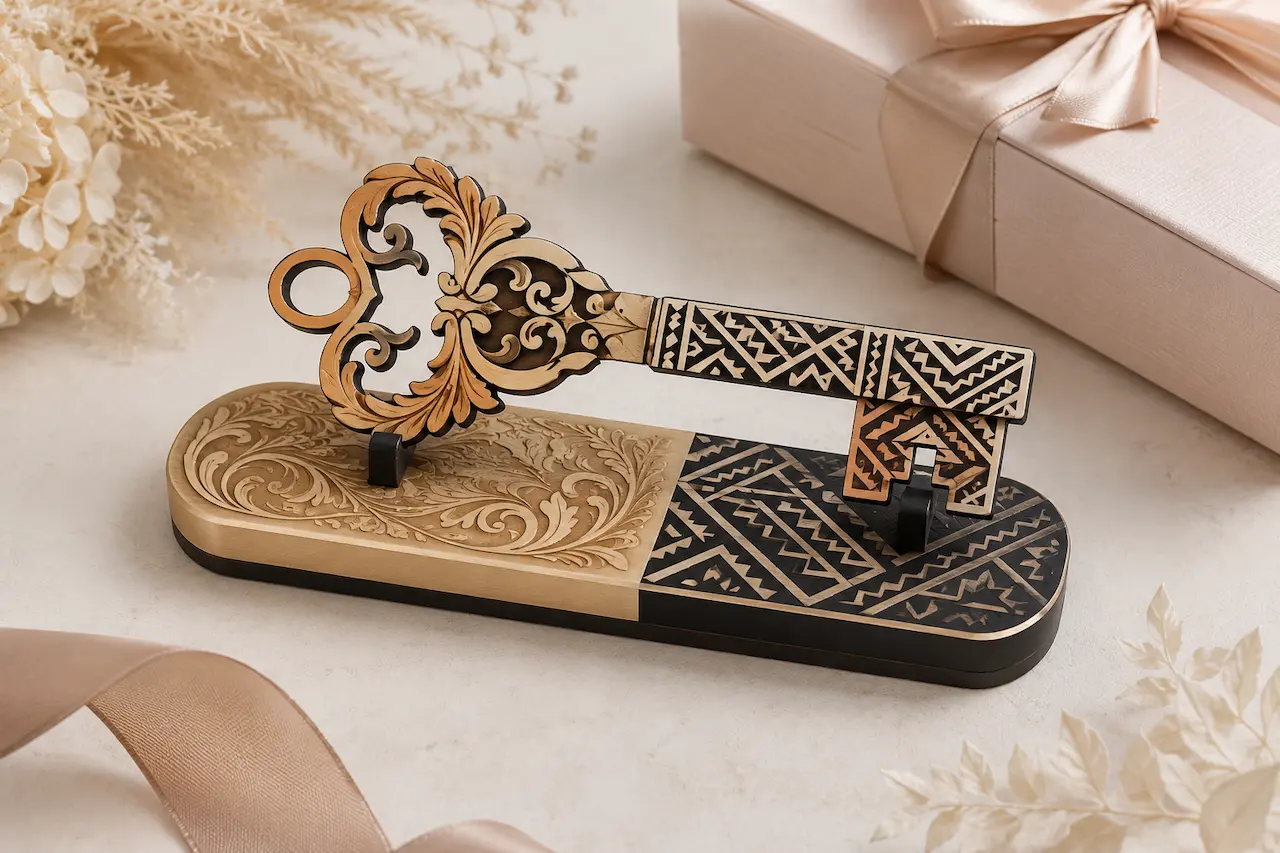
At Birthday Keys, our exclusive Click n Connect stand system was designed in house specifically around each key we produce. This means the stand is never a generic rectangle holder it is a custom piece built to the exact dimensions of the key it holds. That design flexibility is what makes it possible to carry a different cultural pattern on the stand than on the key itself, while the two pieces still work together visually as one complete object.
A Samoan geometric pattern on the key surface paired with a Cook Islands tivaevae-inspired design on the stand does not look like two separate things placed next to each other. When the colours are chosen thoughtfully and the design balance is right, the two pieces read as a single intentional work that honours both sides of the family.
This approach has become one of the most requested options in our ordering process, and the results consistently draw the strongest responses at 21st celebrations because the key tells a story that a single-culture design simply cannot.
Find out why our Click n Connect stand system makes dual culture designs possible in a way standard stands cannot.
Which Cultural Combinations Work Best Together
Not all cultural pattern combinations present the same design challenges, and understanding the visual characteristics of each culture helps set realistic expectations before you order.
Samoan and Tongan patterns share a geometric visual language built from strong lines, triangles, and repeated motifs. These two cultures sit naturally alongside each other on a key or stand because the structural logic of the patterns is compatible. Fijian masi designs carry a similar geometric boldness and integrate well with Samoan or Tongan work.
Maori designs introduce a more organic, flowing visual language built around the koru spiral and curved forms. Pairing Maori patterns with the strong geometry of Samoan or Fijian work requires more considered placement, but the contrast when handled with care creates a result that is visually striking and culturally meaningful.
Cook Islands tivaevae-inspired designs carry a layered intricacy that works beautifully as a stand design when the key surface carries a bolder geometric pattern. The contrast in complexity between the two creates visual interest without either culture overshadowing the other.
A Real World Example
A family from Queensland came to us for their daughter’s 21st birthday key. Her father was Samoan and her mother was from the Cook Islands, and the family wanted both cultures present without one being reduced to a secondary detail.
We worked through both approaches with them during the quote process. The decision they landed on was a Samoan pe’a-inspired geometric pattern across the key surface in deep navy and gold, paired with a Cook Islands tivaevae-inspired design on the Click n Connect stand in a complementary warm palette. The two pieces were designed simultaneously so the colours spoke to each other across both surfaces.
When the key was presented at the celebration, her mother cried. Her father said it was the first time he had seen a gift that genuinely held both sides of his daughter’s identity without one diminishing the other. That response is exactly what a thoughtfully designed dual culture birthday key should achieve.
What to Prepare Before You Order a Dual Culture Key
Ordering a dual culture birthday key requires slightly more preparation than a single culture design, and coming to the quote process with clear answers to a few key questions makes the entire experience significantly smoother.
The information that helps us most when designing a dual culture key includes:
- The primary cultural heritage of the recipient and which culture holds the strongest personal connection
- The second cultural background and whether it should appear on the key surface, the stand, or both
- Whether there are specific motifs, totem symbols, or family crests within either culture that should be included
- Colour preferences for both cultural elements and whether the family has a preference for the colours to match, contrast, or complement each other
- Whether the recipient has a preference for bold geometric patterns, flowing organic designs, or a combination of both
Contact our team directly to discuss your dual culture design before submitting your quote.
How the 3D Draft Process Works for Dual Culture Designs
The 3D draft stage is even more important for dual culture birthday key orders than for single culture designs, because there are more elements to balance and more decisions to confirm before production begins.
Within 24 hours of submitting your quote, we send back a detailed 3D rendered draft that shows both the key surface and the stand together colours, patterns, placement, and finish all presented as the complete piece will appear in real life. For dual culture orders, this draft shows exactly how the two cultural elements interact with each other and whether the balance between them feels right.
Families ordering dual culture keys almost always use the draft stage to make at least one adjustment — a colour shift, a pattern placement change, or a decision to move one cultural element from the key to the stand or vice versa. This is exactly what the draft process is for, and we encourage families to use it fully before confirming production.
Read about what a quality 21st birthday key should look like so you know what to expect from your draft.
Conclusion
Two cultural patterns on one 21st birthday key is not only possible when done with care and intention, it produces some of the most meaningful keys we create. The key is understanding which approach suits the specific cultures involved, using the key and stand as a unified dual culture system, and taking full advantage of the 3D draft process to confirm the balance is right before production begins. At Birthday Keys, this is one of the most rewarding parts of what we do.
Why Choose Us
At Birthday Keys, we have spent years working with families from mixed cultural backgrounds and we understand that honouring two heritages on one piece requires more than just placing two patterns next to each other.
- Our exclusive Click n Connect stand system allows the key and stand to carry different cultural patterns as a unified dual culture piece
- We work with Samoan, Maori, Cook Islands, Fijian, Tongan, and a wide range of other Pacific and indigenous cultural patterns
- Every dual culture order includes a free detailed 3D rendered draft within 24 hours showing both cultural elements together before production begins
- Our in-house design team guides every family through the best approach for their specific cultural combination before the draft is produced
- We complete every order within four days at no extra cost with express Australia-wide delivery and full tracking
Frequently Asked Questions
Can a birthday key have two different cultural patterns?
Yes. The most common approach is to carry the primary cultural pattern on the key surface and the second cultural heritage on the stand, creating a unified piece that honours both backgrounds without either overshadowing the other.
Can the key and stand have completely different cultural designs?
Yes. Our Click n Connect stand system is custom designed around each key, which means the stand can carry a completely different cultural pattern while still working as a visually unified piece with the key.
Which cultural pattern combinations work best together?
Geometric Pacific patterns such as Samoan, Tongan, and Fijian designs pair naturally together. Maori patterns require more considered integration when combined with bold geometric work, but the result can be striking when handled carefully.
How do I know which culture should go on the key and which on the stand?
We guide every family through this decision during the quote process. Generally, the culture with the strongest personal connection to the recipient goes on the key surface, while the second heritage is represented on the stand.
Do dual culture birthday keys cost more than single culture designs?
Pricing depends on the specific design complexity, size, and customisation details rather than the number of cultures included. All costs are shown transparently during the ordering process with no hidden fees.
